

Brand differentiation is one of those concepts that sounds straightforward until you have to put it into practice. Every organisation wants to stand out, communicate its value and give people a reason to choose it over alternatives. Yet, when you look at how many organisations describe themselves, you begin to notice how similar their messages can be, even when the work they do is quite different.
Words such as innovation, excellence, impact, empowerment and transformation appear frequently in brand messaging. These ideas may genuinely reflect what an organisation stands for, but when everyone uses similar language to describe their value, it becomes difficult for an audience to distinguish one organisation from another.
This is where brand differentiation becomes important. It requires an organisation to look beyond what it does and understand what makes its approach, capabilities or contribution meaningfully different from others in its space.
Working in an innovation hub has given me a different perspective on this. It has made me think more carefully about the relationship between what an organisation actually does, what it communicates and what people eventually remember about it.
What Does Brand Differentiation Actually Mean?
Brand differentiation is the process of establishing meaningful distinctions between an organisation and others operating in the same or related spaces. It involves identifying the qualities, capabilities, experiences or value propositions that make an organisation relevant to its intended audience and communicating those distinctions clearly.
However, differentiation is not simply about being different for the sake of it. An organisation can have a distinctive name, an unusual visual identity or a unique way of presenting itself without giving its audience a compelling reason to care.
The difference needs to mean something.
For example, two organisations might offer business support to startups. One might focus primarily on business planning, mentorship and investor readiness, while another might combine those services with access to technical expertise, equipment and facilities that help founders develop working prototypes. Both organisations support startups, but their capabilities and the value they offer may be quite different.
The opportunity for brand differentiation lies in understanding those distinctions and making them clear to the people who need the services.
This is why I see brand differentiation as more than a messaging exercise. It requires an organisation to understand its strengths, the needs of its audience and the particular contribution it makes within its ecosystem. Communication then becomes the means through which that value is understood, rather than a collection of statements about how good the organisation is.
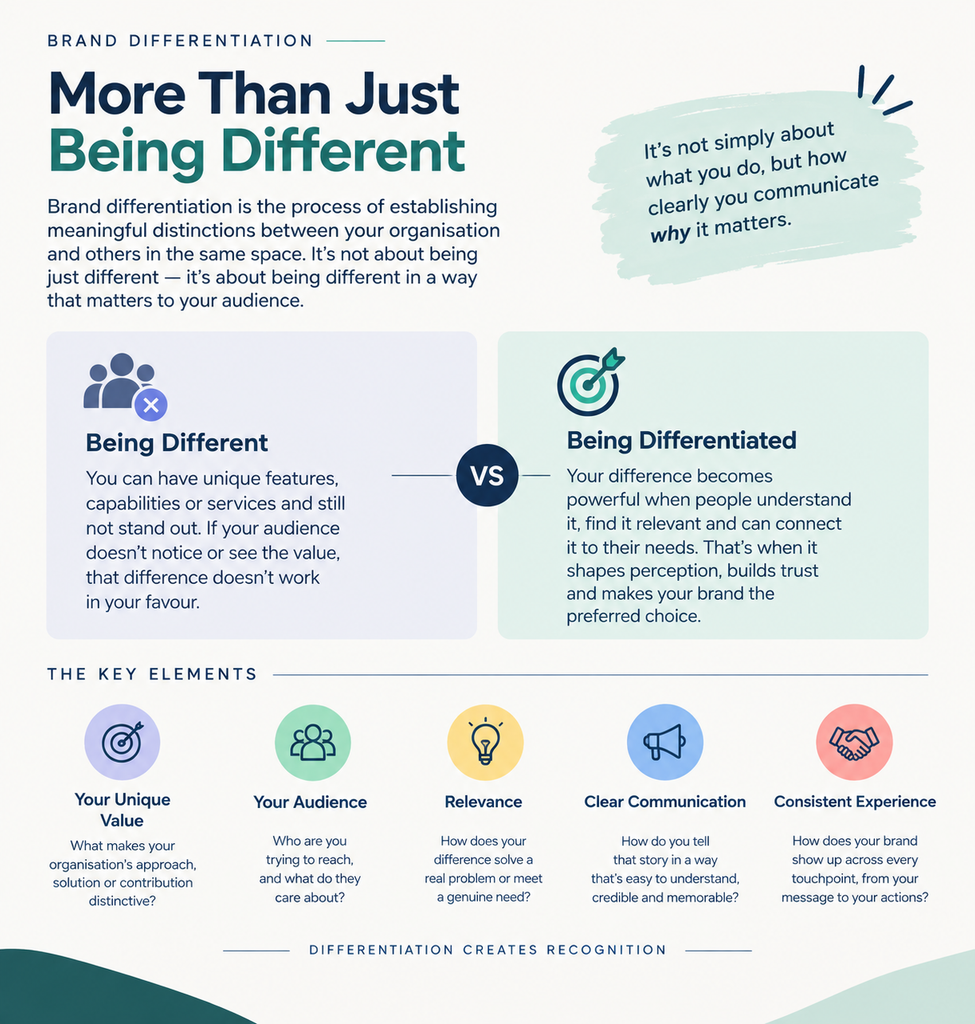
Being Different and Being Recognised for It Are Two Different Things
One thing I have come to appreciate is that an organisation can have genuine points of difference without being recognised for them.
The capabilities may exist, the expertise may be there and organisation may be doing work that is valuable and difficult to replicate. But if its communication does not make those distinctions clear, the audience may form a much narrower impression of what it offers.
This can happen when organisations try to communicate everything they do with equal emphasis. Programs, partnerships, events, training activities, achievements and services all compete for attention, and the central message can become difficult to identify.
There is nothing inherently wrong with communicating a broad range of activities. In fact, organisations with multiple capabilities need to demonstrate the full scope of their work. The challenge is ensuring that the audience can see how those activities connect and what they collectively say about the organisation.
Without that clarity, an organisation risks being known for individual activities rather than for the distinctive value that connects them.
That distinction has become particularly interesting to me while working in the innovation ecosystem.
The Challenge of Brand Differentiation in an Innovation Hub
Innovation hubs operate in an environment where there can be considerable overlap in the services different organisations provide. Depending on their models and areas of focus, hubs may offer entrepreneurship training, incubation, startup support, research collaboration, access to networks, technical facilities and other forms of assistance for innovators.
These activities are important, but they can also make differentiation more challenging. When several organisations describe themselves as places where innovators receive support, entrepreneurs develop ideas and technology-driven solutions emerge, what helps an audience understand the difference between them?
I have found that answering this question requires looking beyond the general description of what an innovation hub does. It means examining how the organisation supports innovation, the capabilities it brings together, the problems it can help solve and the point at which its contribution becomes particularly valuable.
This is something working at Innov8 Hub has taught me to consider more closely.
What Working at Innov8 Hub Has Taught Me
One of the things I have come to recognise about Innov8 Hub is the importance of its role in helping innovators move beyond ideas towards building tangible solutions.
There is a difference between helping someone acquire knowledge about innovation and supporting that person in developing a solution. Both are valuable, and both may be necessary, but they are not the same contribution.
Innov8 Hub supports human capacity development, connects research to industry, provides business support for startups, facilitates intellectual property protection and commercialisation, and supports prototype development. These capabilities are connected, but I believe the practical support available to innovators who need to build their solutions deserves particular attention when we think about what distinguishes the organisation.
For me, this raises an important branding question: how do you communicate the full range of an organisation’s work without allowing its most distinctive capabilities to disappear within the broader narrative?
Human capacity building is an important part of what we do, but it is not the entire story. When the organisation is understood mainly through that lens, people may not fully appreciate the technical support, prototype development and other capabilities that help innovators take their ideas further.
The challenge, then, is not necessarily that the organisation lacks differentiation. It is that the distinction needs to be made clearer.
This is an important lesson for brand management because it shifts the focus from simply communicating activities to deliberately shaping how the organisation is understood.
Why Your Strongest Differentiator Can Get Lost in Your Messaging
When an organisation does several things, there is a natural temptation to communicate all of them whenever an opportunity arises. Every programme is important to the team responsible for it, every partnership deserves recognition, and every achievement contributes to the organisation’s story.
The difficulty is that what feels equally important internally may not carry equal weight in the audience’s understanding of the brand.
A potential partner may want to know about the organisation’s technical capabilities. An entrepreneur may be looking for practical support to develop a prototype. A researcher may need help connecting academic work to industry, while a startup may be more interested in intellectual property protection or commercialisation.
These audiences have different needs, and they may encounter the same organisation from very different starting points.
A brand strategy needs to account for these differences while maintaining a coherent identity. Rather than treating every activity as a separate message, the organisation needs a central narrative that explains its role and shows how its various capabilities support that role.
In the case of an innovation hub, that might mean communicating not just that it offers training, startup support and research collaboration, but also how these capabilities contribute to helping innovators develop and advance solutions.
The distinction is subtle but important. One approach presents a list of services; the other gives the audience a clearer understanding of the value those services create together.
Brand Differentiation Starts With Understanding the Organisation
This is also why I believe brand professionals need to understand the organisations they represent beyond their communication channels.
It is difficult to identify a meaningful point of difference if your understanding of the organisation is limited to its existing messaging. You need to know what happens behind the scenes, how the services work, what problems the organisation is equipped to solve and where its capabilities offer particular value.
In an innovation environment, this can mean understanding the relationship between research, technical development, prototyping, intellectual property and commercialisation. It may involve speaking with technical teams, learning about the work being undertaken in different programmes and asking questions that reveal what the organisation can actually deliver.
That knowledge helps a brand professional distinguish between what the organisation says it does and what its capabilities enable it to do.
It also makes communication more credible. Instead of relying on broad claims about innovation and impact, the brand team can explain the work in concrete terms, demonstrate its relevance and help audiences understand why it matters.
This kind of understanding cannot be developed through content planning alone. It requires curiosity about the organisation and a willingness to engage with the people responsible for delivering its work.
Differentiation Must Be Demonstrated, Not Just Declared
There is another important consideration here: an organisation cannot establish meaningful differentiation simply by claiming to be different.
A statement about being innovative, technically advanced or committed to impact is only the beginning. The organisation needs evidence that supports the claim.
That evidence might include the solutions it has helped develop, the capabilities available to innovators, the partnerships that enable its work, the problems it has helped address or the outcomes achieved through its programmes.
For innovation hubs in particular, communicating tangible work can help audiences understand what innovation looks like in practice. It gives substance to a message that might otherwise remain abstract.
This does not mean every communication needs to become a technical report or an exhaustive account of a programme. The task is to identify the most relevant evidence and present it in a way that helps the audience understand the organisation’s contribution.
Good storytelling plays an important role here, but the story must be grounded in the work itself. Brand communication can make a genuine distinction easier to recognise; it cannot substitute for the underlying capability.
What This Has Changed About How I Think About Branding
Working in innovation has reinforced my view that brand differentiation is not simply about finding a clever way to describe an organisation. It is about understanding what the organisation brings to its ecosystem and making that value easier for people to recognise.
It has also made me more conscious of the need for hierarchy in brand communication. An organisation can have many valuable services and still need to decide which capabilities should lead its positioning, which ones reinforce that position and how the different parts of its work fit into a coherent story.
That does not mean ignoring the less prominent parts of the organisation’s work. It means giving each part the right place within the broader narrative.
For brand professionals, this requires a combination of strategic thinking, organisational knowledge and communication skills. You need to identify the distinctions that matter, understand which audiences care about them and communicate the value without oversimplifying the work.
Most importantly, you need to recognise that the way an organisation is described can influence what people notice about it, what they associate it with and whether they understand its relevance.
Final Thoughts
Working in an innovation hub has taught me that having valuable capabilities and communicating them effectively are two different challenges. An organisation may be doing meaningful work across several areas, but its audience still needs a clear reason to understand what makes it distinctive.
For Innov8 Hub, the opportunity I see is in ensuring that the full scope of its work is understood, particularly its role in helping innovators develop tangible solutions rather than allowing that contribution to be overshadowed by the broader category of human capacity development.
The wider lesson extends beyond innovation hubs. Whether an organisation operates in technology, finance, education or another sector, brand differentiation requires more than listing services or claiming to be unique. It requires clarity about the value an organisation creates, evidence that supports its claims and communication that makes its contribution meaningful to the right audience.
An organisation does not become differentiated simply because it does something valuable or different. It becomes recognisable for that difference when people understand what it is, why it matters and what makes its contribution worth remembering.